DMARC Monitoring & Spoofing Alerts
Your emails reach inboxes until they don't.
DMARC reports arrive as gzipped XML that nobody reads. We parse them and alert you when something drifts.
No credit card required. Free tier monitors 1 domain. See pricing
From: digest@dmarcdrift.com
Subject: DMARCdrift digest: theirsite.com

  _dmarc.theirsite.com     p=none

  7d alignment    86.3%   ↓ was 99.1%
  Messages        8,200   over 6 reports

  ⚠  Alignment regression detected
     New sender: 103.86.1.0/24 (unknown)
     350 messages · 0% aligned
     → This source may be spoofing your domain

  Senders:
     Google Workspace   4,200 msgs   99.8% ✓
     Mailchimp          1,800 msgs   86.3%
     Outlook            2,200 msgs   86.2%

  → Review this domain  dmarcdrift.com/d/…
From: alerts@dmarcdrift.com
Subject: [alert] New sender: theirsite.com

  ⚠  Unknown sender detected
     103.86.1.0/24 · ASN 45090 (CMCC)
     350 messages · 0% DMARC aligned

  → Review sender  dmarcdrift.com/d/…
Deliverability fails silently.
By the time a customer tells you their password reset went to spam, you've already lost emails. DMARC aggregate reports are the earliest signal that something is wrong with your domain's alignment, but they arrive as gzipped XML, and unless you're running a monitoring stack, you read zero of them.
Every ESP you use (Resend, Postmark, SendGrid) affects your DMARC alignment. Add a new marketing tool, misconfigure an SPF record, and alignment quietly drops. You won't see it until Google does.
Postmark charges $14 per domain per month for their DMARC monitor. If you run eight domains across your projects, that's $112 per month to know what you could know for $9. Self-hosting parsedmarc is the other option: a Saturday well spent learning what alignment_mode: relaxed means.
<feedback>
  <record>
    <row>
      <source_ip>209.85.220.41</source_ip>
      <count>4200</count>
      <policy_evaluated>
        <disposition>none</disposition>
        <dkim>pass</dkim>
        <spf>fail</spf>
      </policy_evaluated>
    </row>
  </record>
</feedback>
What DMARCdrift does with your reports
Parse
Every report arriving at your rua= address is fetched, decompressed, and parsed. Alignment tracked across SPF and DKIM for every sending source. You never touch the XML.
Summarize
Alignment percentage, message counts, and every sender organized by volume, flagged when unrecognized. Weekly or monthly, your choice.
Alert
When alignment drops, an unknown source appears, or your DMARC record changes, you get a direct alert. Most domains: fewer than one per week.
If your alignment is stable and your senders are recognized, you hear nothing. That's the point.
How it works
- 01
Sign up
Create a free account. No credit card required.
- 02
Add your domain
You get a dedicated inbound address:
d-<id>@in.dmarcdrift.com. Add it to your_dmarcTXT record as therua=value. We show you the exact record to set. - 03
Reports start flowing
Google, Yahoo, and Microsoft send aggregate reports to your address within 24–48 hours. We parse them, track alignment, and email you a digest. You do nothing.
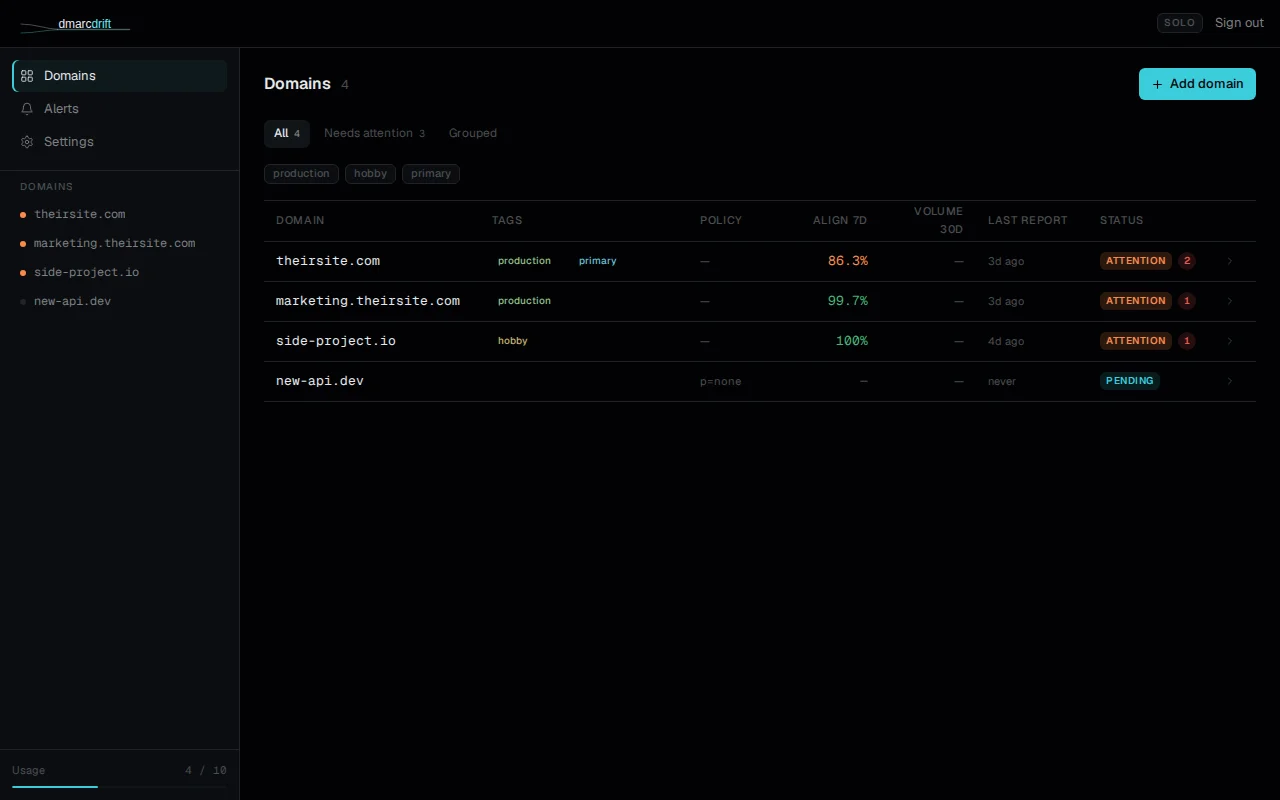
Glance once. Move on.
All your domains in one view. Click into any row when an alert fires, review the sending source, and close the tab. Most weeks you never open it.
This isn't for you if…
- –You need a compliance audit trail or regulatory reporting.
- –You have a security team that handles email authentication.
- –You need BIMI setup support or logo-in-inbox certification.
- –You need multi-user workspaces or role-based team access.
For enterprise DMARC, dmarcian, easydmarc, and Valimail exist. They're good at what they do.
Simple pricing. Pays for itself the first time it catches something.
No per-domain fees. Most competitors charge $14 per domain. Solo covers 15 domains for $9 flat.
Recommended
Solo
$9/mo
or $90/yr (save two months)
- Up to 15 domains
- 180-day report view
- Digest + alert emails
- DNS change detection
- Spoofing signal alerts
Pro
$29/mo
or $290/yr (save two months)
- Unlimited domains
- Full 365-day view
- Webhook endpoints
- REST API keys
- Email support
Upgrade from the dashboard after signup.
From the blog
All posts →New to this? Start with our guide to setting up email for a new SaaS.
Sep 23, 2026
DMARC Adoption, September 2026: The Library of Congress Locks Down 18 Domains
Our September scan of 2,240 domains: 83.3% publish DMARC and 68.5% enforce p=reject. Most of the real movement came from one agency locking down domains that never send mail.
Aug 19, 2026
What DMARC Monitoring Actually Costs
DMARC monitoring prices from eight vendors, verified on a single day, and why domain caps rather than email volume decide what a multi-domain developer pays.
Aug 8, 2026
DMARC for SaaS founders: why your sending sources multiply without you noticing
Your SaaS product sends email from multiple sources simultaneously, and each one needs DKIM alignment with your domain. Here's why that visibility gap matters.
Know before your customers do.
Five minutes to set up. We watch your DMARC alignment.
You ship things.